Share This

Deepseek https://www.deepseek.com/./深度求索 DeepSeek | 深度求索 https://askaichat.app/chat
Showing posts with label Scam. Show all posts

Friday, 5 December 2025

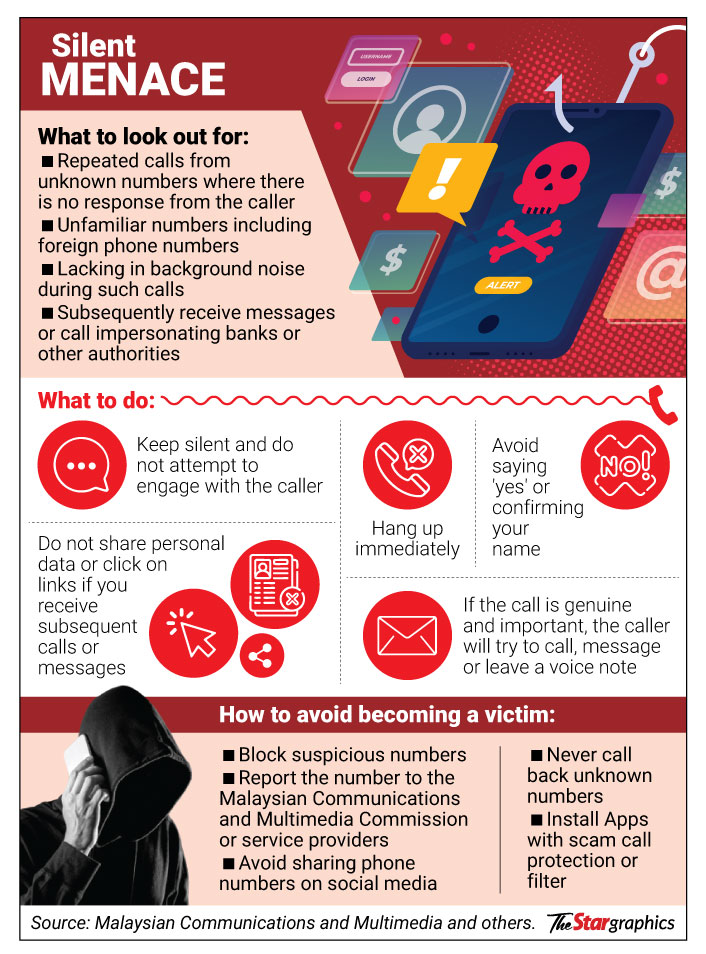
Silence is golden in new call scam


This visual is human-created, AI-aided.

AI used to gather sound metadata to clone voices

PETALING JAYA: Silence is golden. This is exactly what one should do to avoid becoming a victim of the latest AI-generated silent call scam, says the Malaysian Communications and Multimedia Commission (MCMC).

A recent video released by Friends of MCMC warning of the latest tactic used by scammers saw several Malaysians coming forward to relate their personal experiences.

Sean Ang, 34, a data analyst from Kuala Lumpur, said he grew suspicious of phone calls from unknown numbers recently.

ALSO READ: Stay smart and be suspicious of scammers

“The calls would come in but there would be no one speaking on the other side.

“Fortunately, I was aware of the latest scam and had also read about how scammers are using AI to dupe people in Thailand.

ALSO READ: Chasing easy money leaves victims with big losses

“When I get such calls from unknown numbers, I will remain silent and hang up if no one is on the other end,” he said when contacted yesterday.

Sabahan Francis Magawun, 43, currently working in Petaling Jaya, said he received calls from unknown local mobile numbers and overseas phone numbers.

“I am a sceptical person by nature and wary of getting unknown calls even before the recent warning issued by the MCMC.

CLICK TO ENLARGECLICK TO ENLARGE

“If I get such calls, I remain silent to see if there is any response before hanging up,” he said.

Magawun is concerned that senior citizens may fall prey to such scams as they are not aware of evolving online threats, particularly those using AI technology.

The silent call is a tactic used by scammers to phish for victims. It begins with ringing up the target, but the caller deliberately leaves the line silent when the call is answered.

By answering, a person is deemed to have an active number and is placed on a target list for scam messages or calls impersonating banks or other authorities.

If the target answers, his voice is recorded and later cloned with AI for impersonation purposes.

The MCMC had recently posted a two-minute video on social media to warn Malaysians that AI technology is being used to gather sound metadata to clone voices.

The AI-cloned voice is then used to scam the target’s family by requesting help due to an emergency, to get a company staff member to transfer money or to by-pass voice verification used by certain commercial institutions.

Mohamed Hussain Rasool Mohd became more alert after reading a warning posted on the Penang Community Facebook page of such modus operandi.

Kaizen Sun, in a posting in the same Facebook page, said those who answered a silent call would usually get follow-up calls the very same day and for the next several days.

“All sorts of numbers – local, mobile and international.

“There was even one WhatsApp text message telling me that he was my long-lost contact from wine trading (and I’m wondering in which lifetime was I involved in the alcohol business),” the post read.

Related stories:

Related News


Thursday, 21 November 2024

rapped in cycle of scams, victims being retargeted over 2.5 times on average

 Low digital literacy blamed for Malaysia's high victamisation rates

Stay vigilant: Victims not learning from experience is among the factors contributing to them being revictimised.

KUALA LUMPUR: Malaysia has the highest rate of online fraud revictimisation in Asia, with victims being retargeted over 2.5 times on average, according to the Asia Scam Report 2024 issued by the Global Anti-Scam Alliance.

CelcomDigi head of sustainability Philip Ling said the report also revealed that Hong Kong and Thailand ranked second and third respectively.

“There are two concerns, namely victims being repeatedly targeted by scammers and their low ability to differentiate artificial intelligence scams.

“The victims don’t learn from experience. It is concerning when they fall victim again because they lack the ability to differentiate between sources ... when contacted by authorities, they often cannot tell whether the caller is real or fake,” he said, Bernama reported.

He said this to reporters after attending the Anti-Scam Engagement Session, “It’s a Matter of When”, at the Tun Abdul Razak Broadcasting and Information Institute here, which saw the participation of over 100 staff from agencies under the Communications Ministry, including the Information Department, the Malaysian National News Agency (Bernama) and RTM.

Ling said the event on Monday provided participants with an opportunity to share information and advocate against crime in a manner that is clearer and easier for the public to understand.

“We need to know that scam victims do not get an adequate support system from the people around them.

“They feel scared, ashamed and unsure of where to seek help,” he said.

One of the participants, Abdul Wahid Abdul Mutallib from Bernama, said that such programmes should be expanded, particularly to the community, as they provide valuable new information and knowledge.

“This kind of programme is very good because it can raise awareness among the public, especially as we are in the age of AI,” he said.

Echoing similar sentiments, another participant Mohd Salehuddin Mohd Kidin expressed hope that more programmes focused on online fraud awareness would be organised at the grassroots level.

“Through courses like this, participants are given exposure on how to ensure that all information is accurate before making any online transaction,” he said.

Earlier, Communications Minister Fahmi Fadzil said online fraud is one of the government’s main focuses in addressing the rise in cybercrime cases, including online gambling, cyberbullying and sexual crimes against children.

In response to this, the government has decided to implement a regulatory or licensing framework for social media and internet messaging services, effective Jan 1 next year.

Source link


Related:

Code amendments put money mules in crosshairs


: Code amendments put money mules in crosshairs

Retiree loses RM570,000 to gold scam

Related posts:

Scam rampant, become a ‘scamdemic', with victims being forced to commit online crimes also believed to have set up scam centres in Malaysia


LETHAL LURE OF JOBS ABROAD, Baited and trapped

Malaysians fail for offers of lucrative jobs overseas only to end up scrammed 


Thursday, 3 October 2024

The Economics of The Halal Scam, A Blockbuster By Sam The CEO.


The following is written by my friend Sam The CEO or Sam The Oilman.


Sunday Sermon: The Economics of The Halal Scam. 

Or How to Make the Clerical and Political Class Rich on the Backs of Muslims and Make Them Poorer

My thesis: The halal concept is a bureaucratic structure made up by the clerical class initially for political power. And like any creation of political power, it was not long before it became a set of regulatory rules that induces payment, i.e. corruption, in order for the ordinary citizen to exist or make an honest living.

Think about this:

1. It creates additional cost for compliance

2. The product is actually still the same but costs more to obtain Halal approval and/or certification

There is ZERO innovation or new products created that provide either a game-changing technology or societal progress for society. 

It is just extra costs for the same damn thing which such extra costs goes into the pockets of the powers that be and their cronies to line-up their pockets. That includes the civil service authorities that are employed at the expense of tax-payers with no productive value. 

Repeat after me:   ZERO PRODUCTIVE VALUE

The Quran never asks Muslims to set up Halal certification. You only need to assess for yourself to your own confidence whether it is halal or otherwise. There is no compulsion on you or others for halal certification. It is your call. It is FOC.

But Halal certification makes money. And in our modern economics, halal certification controls whole industries and prints money for those with the power to create and maintain such systems. And muslims become poorer for it.

The Halal Banking Scam

Don't just think about food. Take the banking and investment sector. Money is money. The source of money is the same. It flows through various industries the way water meander through rivers, oceans, up to the clouds and rain back down to earth in a cycle. There is no halal water. There is no halal money. There is only money.

None of the loan you take on syariah terms makes any sense.
They still charge you interest. They just don't call it interest. The Quran forbade "usury" i.e. "making obscene profits" not interest. Instead today, any cursory review shows that syariah-compliant loans often have effectively usurious interest rates compared to non-syariah loans. But why not? Because:

1. You have now entrapped muslims into a system where they think this is the only choice for the islamic ethical system of "halal" - so charge more for this monopoly. You now can funnel muslim money based on this "ethical" conundrum.

(ps. BlackRock invented its halal investment: ESG. And they have their own halal/ESG certification ratings body)

2. Just for this certification, it will naturally cost more because the money is from the same banking system but with the halal system adding another layer of costs.

This is basically re-badging a product. Import the car from China and put the Pr*t*n logo on it and call it Halal. Charge 'em more. 


Conclusion

1. The Halal System is maintained to make money for the political and clerical/authority class and their cronies. Nothing more, nothing less. But the clerics can make people stupid and don't think. So what else are we going to do? S*d*mise them as much as you can.

2. A society that is this dumb, wastes time and money on unproductive economic activities - making this and that halal, having it certified halal. None of which creates anything new. There is no innovation, creativity or even productivity. It is in fact counter-productive. It is a net negative economic sector for the population as a whole. If there is innovation - it is the innovation the way scammers innovate to scam their victims. That's about it.

Such a society cannot evolve to be a civilised and progressive society because its economic focus is on a negative productivity sector with no industrial innovation and the money goes down the drain of corruption.

There is a lesson to be learnt here somewhere. If only we think. 

Source link

Saturday, 22 June 2024

Millions stolen from bank with insider help; Theft prompts security review

KUALA LUMPUR: The suspects linked to the siphoning of millions from a bank targeted their victims based on insider information, says Bukit Aman.

Bukit Aman Commercial Crime Investigation Department (CCID) director Comm Datuk Seri Ramli Mohamed Yoosuf (pic)said the group stole the money in stages after they had identified high-value account holders.

“The money was taken out via the bank counter and the first one was conducted around April. Several more were done in May and June.

“With inside help, the money was taken out according to bank procedures. The case only came to light after an account holder went to the bank to update details,” he said at a press conference yesterday. 

He said it was possible that syndicate members who were working in the bank also directly facilitated the transactions.

Among those caught included a bank manager.

Investigations showed that the mastermind had expertise in forgery and the syndicate members would use forged identifications to take money out of targeted accounts. 

“The details would be the same but the photo and thumbprints would be changed,” he said, adding that forged documents were then used to facilitate the money transfers.

Meanwhile, another case has been detected, with losses involving RM551,000.

“This was done at another bank earlier in the year and we are also investigating that case,” he said.

When contacted, Comm Ramli said 13 people, including four bank employees, were detained recently in connection with millions of ringgit that vanished.

Arrests were mostly made in Kota Kinabalu with one suspect caught in Padang Besar, Perlis.

The case is currently being investigated under Section 420 of the Penal Code for cheating.

“The involvement of bank personnel in commercial crime is a very serious matter.

“In the past, we have encountered cases where bank personnel were complicit in crimes such as criminal breach of trust or embezzlement.

“There are also those who were in cahoots with theft or scam syndicates,” he said.

Comm Ramli urged financial institutions to improve their security such as tightening procedures or imposing stricter measures in regard to withdrawal from accounts.

“Such measures are necessary to prevent theft or missing funds from customers’ bank accounts.

“We feel that improvements are needed for the sake of the account holders,” he said.

From 2022 to June 15 this year, a total of 485 cases of missing funds from bank accounts have been recorded involving RM35.01mil in losses.

“From the overall statistics, this year alone we recorded RM25.76mil in losses and 65 cases.

“The highest number was 225 cases last year, but it involved only RM4.82mil, followed by 195 cases in 2022 involving RM4.42mil,” he said.

Besides the involvement of “inside men” in financial institutions, Comm Ramli said another factor that could have contributed to the missing funds was disclosure of banking details to a third party.

“Our investigations revealed that some victims might have intentionally or unintentionally revealed details of their online banking username and password,” he said.

Comm Ramli said scammers are known for using the phishing technique to dupe victims via email or text messages.

He advised the public to stay vigilant and be wary of tactics used by scammers.

Sorce link

Related stories:

Theft prompts security review

RM24mil bank fraud: Inside men picked high-value accounts to hit, says CCID director

Theft prompts security review


d9c10f09-7654-496c-af1e-0af847d1b361

PETALING JAYA: A recent embezzlement case involving bank staff in Kota Kinabalu has sparked calls for tighter security measures in financial institutions.

Universiti Sains Malaysia criminologist Datuk Dr P. Sundramoorthy (pix) said the recent case that saw over a dozen arrested was both concerning and a wake-up call.

“Although the number of wrongdoings and criminal acts by bank employees may be very minimal, it cannot be ignored.

ALSO READ: RM24.2mil fraud: BNM requests prompt refunds to all affected account holders 

“The rakyat, investors and the business community depend on the banks to safeguard their money.

“We don’t have a choice in this matter.

“Banks must aggressively play a role in eliminating undesirable employees,” he said, adding that banks need to invest in internal security and loss prevention departments, even if it incurs costs.

“These departments should have the expertise to detect embezzlement, fraud and misconduct by employees,” he said.

“Security investments are assets, not liabilities.”

ALSO READ: Millions stolen from bank with insider help

Drawing comparison with law enforcement bodies, he added that employees at highly sensitive areas should be rotated to avoid any potential for leakages within the bank, even if they are competent in their jobs.

“This is especially important for positions with access to customer accounts,” he said.

Pre-employment screening must also be done for all employees with regular assessments for those in service, he added.

Duties must also be “robustly” segregated, with dual authorisation practices implemented as well.

“That was a substantial amount of money (lost) and I hope measures will be taken.

“Since it was an inside job, the bank must be responsible for covering every single ringgit and sen that was misappropriated.

“Banks must be proactive and they should work together with the victims and law enforcement to ensure such incidents are reported.

“Employee pilferage is not new but it is also not frequent. We must not tolerate it,” he said, adding that harsh penalties and criminal charges must be meted out on those involved.

Such cases, he said, also affects the credibility of the bank involved as customer confidence will drop.

Previously, Bukit Aman Commercial Crime Investigation Department (CCID) director Comm Datuk Seri Ramli Mohamed Yoosuf said that four police reports were lodged since early June regarding suspicious transactions, with losses estimated to be around RM24.2mil.

As of June 18, the police have arrested 13 suspects aged between 22 and 52 years old.

Four suspects were found to be employees of the bank. 

https://www.thestar.com.my/news/nation/2024/06/22/theft-prompts-security-review

Related stories:

RM24.2mil fraud: BNM requests prompt refunds to all affected account holders


Related posts:


BLACK SHEEP IN BANKS, Employees you cannot bank on, Calls for banks to bolster cyberdefences


Wednesday, 4 December 2019

Top spammers and scammers in Malaysia by anti-spam mobile app Truecaller

If you’ve been getting a flood of automated phone calls lately about outstanding traffic summonses or a parcel delivery you know nothing about, here’s the likely reason.

Statistics from an anti-spam mobile application show that over the past 12 months, Macau, parcel and other scam syndicates have been making more calls to trick Malaysians into handing over money.

Truecaller – which claims to have 150 million daily active users worldwide – said there has been a 24% jump in the average number of spam calls received by its one million users in Malaysia this year compared to 2018.

The mobile app, which has offices in Sweden, the United States and India, said it has helped users in Malaysia identify and block 90 million spam calls so far this year, typically from telemarketers offering telecommunications, insurance and credit card products and services.

Scam calls are a form of fraudulent activity with the goal of stealing the victim’s money.

Last year, scam calls – including those by Macau Scam syndicates – made up a mere 1% of spam calls received by the app’s Malaysian users.

This year, the figure has ballooned to a whopping 63%, according to the Truecaller Insights 2019 report.

The Macau, parcel and “Astro” scams are among the top scams in the country over the past year, the report noted. The modus operandi of a Macau Scam is by impersonating someone with authority, such as a policeman or a bank officer, and convince the victims over the phone that they need to pay money to avoid trouble.

For parcel scams (which are also sometimes referred to in Malaysia as love scams), the scammer would strike up a relationship with the victims online, and then convince them to send money so that a parcel said to contain a valuable gift for the victim can be “released by authorities”.

In the Astro scam, someone impersonating a representative from the satellite TV provider would call a potential victim to deliver a warning.

“Input we’ve gotten is that they would say you have an unpaid bill and that needs to be paid right away, otherwise you’ll be reported for it, ” a Truecaller representative said.

The report’s findings are reflected in official figures on losses suffered by the victims.

Police statistics show that of the five currently active syndicated commercial crime cases this year, investment scams took the number one spot, recording the biggest losses at RM200.78mil, with Macau Scam in second and parcel scams third.

On Nov 12, Deputy Home Minister Datuk Mohd Azis Jamman said 1,911 Malaysians lost RM94.04mil to Macau Scam this year, while 1,303 lost RM67.74mil to parcel scams.

According to the Truecaller report, Malaysia is the mobile app’s 19th most spammed country. In first place is Brazil, where Truecaller users receive an average of 45.6 unsolicited calls a month, followed by Peru (30.9), Indonesia (27.9), Mexico (25.7) and India (25.6).

While Malaysia may not be the most spammed country it does hold another unsavoury record.

“Analysing this year’s data, we can see that Malaysia is the market that receives the biggest percentage of scam calls in the world, ” the report said.

Malaysia is trailed by Australia (60%), Lebanon (49%), Canada (48%), and South Africa (39%). The police have a Facebook account, Cyber Crime Alert Royal Malaysia Police (https://www.facebook.com/CyberCrimeAlertRMP/) to warn the public about scams.

A web portal set up by the police, http://ccid.rmp.gov.my/semakmule, allows people to verify telephone numbers and bank accounts that could be used for scamming.

 Source link


Spam calls up by nearly a quarter in Malaysia: anti-spam mobile app Truecaller


PETALING JAYA: Malaysia has seen a 24% rise in the number of unsolicited (spam) calls this year which includes those from Macau Scam syndicates, according to anti-spam mobile application Truecaller.

Truecaller - which claims to have 150 million users worldwide – said its one million daily active users in Malaysia received more than 90 million spam calls so far this year that the app managed to block.

"Over the past 12 months Malaysia has seen a 24% increase of spam calls, going from 6.7 spam calls per month to 8.3," the Truecaller Insights 2019 report said.

The report said Malaysia ranked 19th among Truecaller market countries in terms of the number of spam calls. Brazil tops the list, with Truecaller users in the country getting an average of 45.6 spam calls this year.

In second place is Peru (30.9), followed by Indonesia (27.9), Mexico (25.7) and India (25.6).

Spam calls are divided into several categories which include scam calls such as those by the Macau, parcel and "Astro scam" syndicates.

Other types of spam calls include those by telemarketers offering telecommunications, insurance and credit card products and services.

The MO for a Macau scam is that the scammer would impersonate someone with authority such as a policeman or a bank officer over the phone and convince the victim that they need to pay money to avoid trouble.

For parcel scams (which are also sometimes referred to in Malaysia as love scams), the scammer would strike up a friendship or relationship with the victim online and then convinces them to send money or entice the victim with a parcel delivery.

In the "Astro scam", someone impersonating a representative from the satellite tv provider would call to warn the potential victim of a supposedly unpaid bill which needs to be settled immediately to prevent a report from being lodged.

The Truecaller report noted that Malaysia is the top country where the biggest percentage of unsolicited phone calls comprises of scam calls.

"Analysing this year’s data, we can see that Malaysia is the market that receives the biggest percentage of scam calls in the world.

On Nov 12, Deputy Home Minister Datuk Azis Jamman said 1,911 Malaysians lost RM94.04mil to Macau scams this year while another 1,303 lost RM67.74mil to parcel scammers.

The Truecaller report said that other than Malaysia, other top countries with the highest percentages of scam calls include Australia (60%), Lebanon (49%), Canada (48%) and South Africa (39%).

The police have a Facebook account, Cyber Crime Alert Royal Malaysia Police to warn the public about scams, as well as a portal for people to verify telephone numbers and bank account numbers that could be used by syndicates carrying out such scams.


 Source link


Related posts:

Hello, Penang police calling ... Macau Scammers reap RM2.7mil


Many investors get their fingers burned in dubious money-making schemes M Mall in Penang where MBI investors can exchange their virtual...


How to outsmart smartphone scammers ?


You carry your smartphone everywhere. But the way you use it could leave you vulnerable to specific forms of identity theft, including robocall scams and hackers looking to hijack your phone number. — AP

Rightways