‘Very Chinese time’

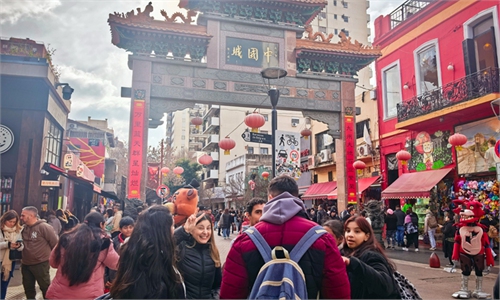
Foreign tourists interact with performers during a lion dance performance at a scenic spot in Sanya, South China's Hainan Province, on January 17, 2026. Photo: VCG
These days, TikTok feeds are filled with a recurring set of visuals: Young people from the US and other countries hold steaming mugs, seriously declaring to the camera, "From tomorrow, I'm turning Chinese."Some replace cold salads with a bowl of hot congee (porridge), some try to boil apple water on the stove for the first time, others slip on thick socks and step into slippers, or try soaking their feet while sipping ginger tea.
One person bought a bag of goji berries for the first time at the supermarket, captioning the video: "Very Chinese time in my life."
These are not isolated acts of curiosity or imitation, but part of a growing global social media trend: "Becoming Chinese."
The hashtag #chinesebaddie has already garnered more than 2,300 posts in the past month, with the algorithm continuously pushing this lifestyle to a wider audience of young users.
On the surface, this appears to be a pop culture trend centered on health and lifestyle. But in the global context of 2026, it carries deeper implications.
When US President Donald Trump officially began his second term, he brought back his "America First" agenda - marked by high tariffs, transactional diplomacy, and relentless pressure on allies - once again forcing the international community to contend with a highly unpredictable US.
A Global Times survey conducted in late December 2025, covering approximately 51,700 respondents across 46 countries and regions, found that, when asked "which country do you have a more favorable opinion of, China or the US?", 39 percent chose China - 1.5 times the number who chose the US (26 percent), while 25 percent viewed both similarly.
Compared with 2024, the share of those expressing a more favorable view toward China rose by 9 percentage points, while the figure for the US dropped by roughly 8 percentage points.
There is a growing recognition that the US itself is becoming a source of global instability. At the same time, countries around the world increasingly view China as an anchor of stability, peace, prosperity and development, Li Haidong, a professor at China Foreign Affairs University, told the Global Times.
"Such reckless moves by the US are instead prompting countries to realize more clearly that China represents opportunity, prosperity and progress," he said.
Looking ahead, if the "Becoming Chinese" trend continues, or evolves into something else, is the world also entering a "Very Chinese Time"?
Turning to China amid geopolitical turbulence

A sign opposing US military intervention in Venezuela hangs on an overpass near the US Capitol in Washington, DC on January 6, 2026. Photo: VCG
As 2026 is barely a month old, the US is already stirring global chaos under the "America First" banner. On January 3, US forces launched a dramatic military strike on Venezuela, capturing Venezuelan President Nicolas Maduro and his wife. The US has also seized multiple Venezuela-linked oil tankers in the Caribbean, tightening control over the nation's resources.The aggression extends further. The US has issued threats against Cuba, Colombia, and Mexico, imposed sanctions on Iran, and even targeted traditional allies. Trump has repeatedly voiced intentions to acquire Greenland "one way or another," threatening tariffs on European countries opposing the idea. Meanwhile, NBC News reported that Trump has intensified his criticism of Canada in private conversations with aides in recent weeks over what he sees as the country's vulnerability to US adversaries in the Arctic.
The Financial Times dropped a commentary on January 17 titled "Trump is making the world fall in love with China." It says, "Countries that once saw American success as their own now view the US as an adversary and Beijing as a model."
A recently published global opinion poll commissioned by the European Council on Foreign Relations shows that in the first year of Trump's second term, a growing number of people believe that "China's already formidable influence will grow - and that this is positive news for their own country and for the world. In other words, Trump may have shaken the globe, but the world is falling for China," the article says.

Protesters demonstrate against the Immigration and Customs Enforcement (ICE) in Minneapolis on January 18, 2026, after Renee Good was shot by an ICE officer on January 7, 2026. Photo: VCG
In this backdrop of unpredictability and coercion, many countries are pivoting politically toward China for stability.South Korean President Lee Jae-myung arrived in Beijing on January 4 for a state visit to China. The visit comes as South Korea seeks to stably manage its relations with China, a key partner in trade, tourism and peace efforts on the Korean Peninsula while also maintaining a strong alliance with the US under the Lee administration's "pragmatic" diplomatic approach, the Yonhap News Agency reported.
The UK government on Tuesday approved the plan for China's new embassy in London, multiple media outlets reported. "The UK government's final approval of the new Chinese embassy can be seen as a phased victory of pragmatic and rational diplomacy over an over-securitized mind-set in the country," Wang Hanyi, a research fellow at the China-UK Center for Cultural Exchange at Shanghai International Studies University, told the Global Times. The decision, he said, shows that honoring international obligations and respecting sovereignty are prerequisites for the sound development of China-UK relations.
Economic realignment shifts to China
A landmark example is Canadian Prime Minister Mark Carney's January visit to China - the first by a Canadian leader since 2017 - resulting in progress in Canada-China relations and rich trade deals.
Western media, including The New York Times, described it as "a major policy shift" to reduce reliance on the US amid tariff threats. Carney described the trip to China as "part of a move to forge new partnerships around the world to end Canada's economic reliance on the American market," the Associated Press reported.
Unlike US calls to "bring supply chains home," China's affordable, innovative products - from EVs to AI technologies like DeepSeek - are seamlessly integrating into global daily life.
Industry data showed on January 14 that China's automobile production and sales both exceeded 34 million units in 2025, setting new record highs, offering new cooperation opportunities and helping to establish a global win-win ecosystem in this sector, the Xinhua News Agency reported.
Meanwhile, the "Becoming Chinese" trend on TikTok is boosting consumption of traditional Chinese health products like congee ingredients and herbal teas, indirectly propelling Chinese brands globally, analysts note.
As the US stirs chaos across the globe, pushing even its own allies toward confrontation and driving up massive political and alliance costs, more countries are waking up to the true nature of the expanding American hegemony. This turmoil is making the world see clearly who the real positive force is: the one actively contributing to global security, stability, and leadership, Dun Zhigang, a research fellow at the Chongyang Institute for Financial Studies at the Renmin University of China, told the Global Times.
US' policies inflict massive shock, uncertainties, and destruction on the US itself and the world, eroding confidence in the future and breeding widespread anxiety, Dun said.
The chosen trend
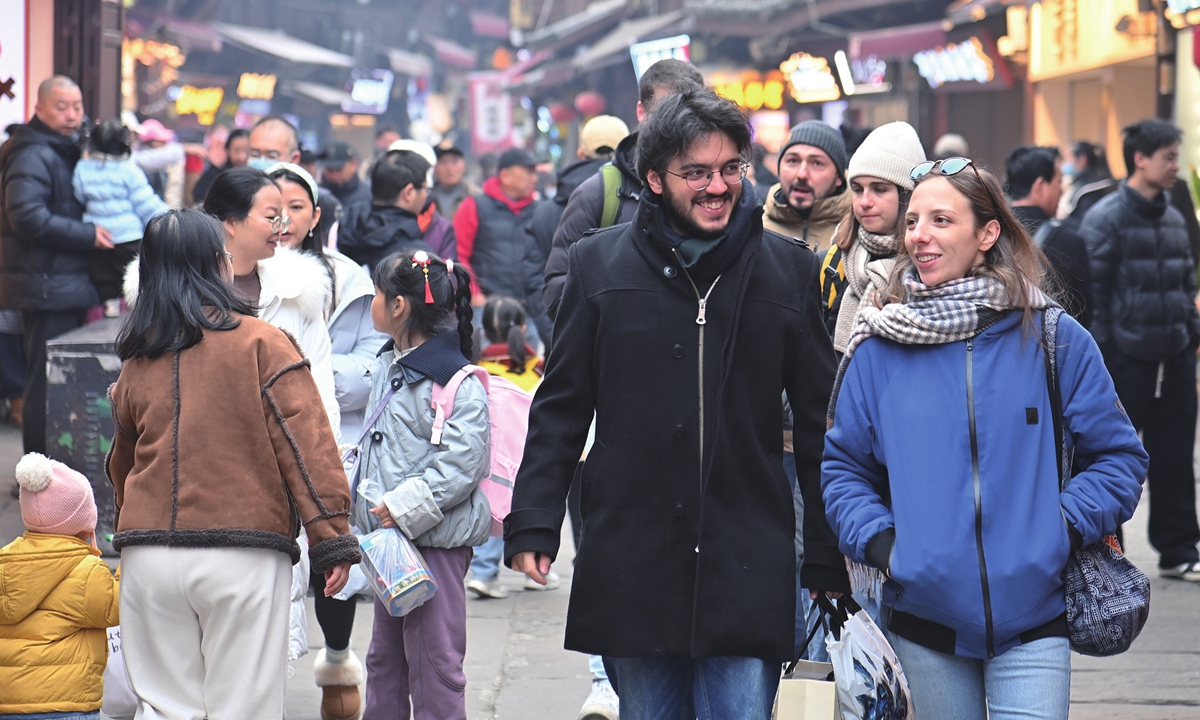
A photo shows an ancient town in Chongqing on January 11, 2026, where Chinese and foreign tourists stream through the streets in an endless flow. Photo: VCG
While shifts in geopolitics and economics often require data and expert analysis to be fully understood, the "Becoming Chinese" phenomenon unfolding across social media serves as a form of global emotional expression that needs no translation.Within this trend, Chinese-style wellness and daily routines have been rebranded as a lifestyle upgrade that is "healthier, more relaxed and more sustainable."
A series of short videos by Chinese creator Sherry Xiiruii under the theme of "Becoming Chinese" have quickly garnered millions of views. Another creator, Emma Peng, plainly states in her video, "My culture can be your culture," with the comments section flooded with phrases like "taking notes" and "this actually works."
The trend has gained such traction that even public figures, including comedian Jimmy O Yang, have taken part. As the momentum builds, new expressions have emerged, including "Chinamaxxing" - a phrase denoting the adoption of increasingly Chinese habits - and the tongue-in-cheek blessing "u will turn Chinese tomorrow," both of which have become popular among young internet users.
Culturally, this is far from the first time China has gone viral in the past year. During last summer, US influencer Speed - known for his hyper-energetic livestreams - caused a social media sensation during his visit to China, attracting tens of millions of views across platforms. His livestreams showed genuine curiosity and enthusiasm for Chinese street food, public spaces and everyday interactions, and were widely praised by netizens in both China and abroad for their unfiltered, cross-cultural engagement.
Other notable examples include the continued popularity of Chinese dramas on international streaming platforms, rising interest in Hanfu, a type of traditional Chinese clothing, among Western youth, and the viral success of Chinese-style aesthetics and music on platforms like TikTok and Instagram.
A Global Times survey conducted in late 2025 showed that over 90 percent of foreign respondents expressed their interest in China, with more than 40 percent indicating a high level of interest.
"Culture" ranked as the top area of interest in the developed countries, while "technology" led in the developing nations. Among recent China-related trends, TikTok and online shopping were chosen by around 60 percent of the respondents, while awareness of Chinese innovations such as robots, drones and smart-driving vehicles surpassed 80 percent.
"Such a trend does not require any deliberate promotion," Li said. "Rather, it is the natural outcome of countries pursuing their own interests and making realistic assessments of the global situation, leading to closer coordination and cooperation with China."
Against this backdrop, China's culture, value propositions and practical approaches are drawing growing international attention, he noted. "Cultural phenomena can serve as symptoms or secondary indicators of geopolitical shifts, offering insights into broader global dynamics."
"It is predictable that as long as China continues its steady path, its international influence will inevitably expand," Li said. "More countries will recognize that aligning with China is choosing the right path. The overall trend is already quite clear."

RELATED ARTICLES